
Orange Baboon (OBT)
Pterinochilus murinus
The OBT — "Orange Baboon Tarantula," or affectionately "Orange Bitey Thing" — is the hobby's most notorious spider, and half that reputation is theatre. From the Usambara region of East Africa, it is a blazing-orange, drought-hardy, obsessive webber that turns any enclosure into a thick silk fortress. It is genuinely fast, genuinely defensive, and carries medically significant venom with no urticating hairs to fall back on, so the caution is real. But kept properly it leans toward flight, poking two legs out of the funnel when hungry and vanishing otherwise. An advanced-keeper icon that rewards respect.
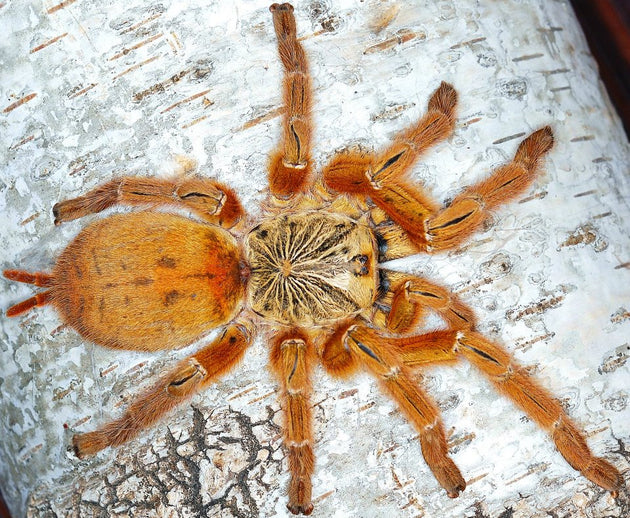
Photo Credit: Exotics Unlimited
- Temperature73–80°F (23–27°C) — mid-to-high 70s is the sweet spot, though it tolerates a wide 65–90°F band better than most. No heat lamp; steady room warmth. It eats hardest in the low 80s and will fast and sit tight when cooler.
- HumidityDry. 50–60% RH at most; adults are best kept essentially bone-dry with a water dish. Slings can have a lightly moist corner. This is a desert animal — wet, stagnant air is far more dangerous to it than dryness. If it webs over the dish (it will), drip a little water on the silk once a week and it drinks the droplets.
- Adult sizeA medium-sized tarantula: adults reach 4–6 inches across the legs (diagonal leg span). A relatively fast grower — expect visible progress between molts when well fed.
- LifespanFemales 10–15 years; mature males 3–5 years. Fast-growing — females can hit 3" in the first year — so a mature male that winds down after his final molt has simply run his shorter clock.
Enclosure
A secure, well-sealed enclosure with escape-proofing taken seriously — this is a curious, fast animal that finds gaps. It keeps terrestrial, fossorial or semi-arboreal depending on mood, so give both several inches of substrate AND vertical anchor points for the web fort. Fill substrate high to keep any climb-and-fall short. Adults do well in a 20×20" footprint or a large tub; slings in deli cups. Ventilation must be generous.
Substrate & water
4–5 inches of dry, packable coco fibre/peat (a mix is ideal), free of pesticides. Keep it dry with a full water dish as the only moisture. It will web far more than it digs, anchoring silk to every wall — that's normal and healthy. Overflow the dish occasionally rather than misting.
Feeding
A legendary hunter with an explosive strike — few species feed harder. Prey no larger than the abdomen: crickets and dubia. Slings once a week (twice if the abdomen is small); adults one item weekly. It signals hunger by poking legs from the funnel; when it's in premolt it walls itself in and fasts, sometimes for weeks.
Temperament & defenses
Advanced only. No urticating hairs, medically significant venom, blistering speed, and a genuine willingness to threat-pose and bite — sometimes with little warning. Set up properly it usually flees, but never bank on it. Never free-handle. Locate it before opening (hard, given the webbing), use long tongs, and rehouse with a deliberate catch-cup plan and a clear escape-free workspace. Not communal.
Keeper’s notes
Our honest take: the OBT's reputation is mostly earned by careless keepers, not the spider. Give it a dry, deep, well-sealed home and it's a hardy, spectacular, wildly active webber that mostly wants to be left alone. For confident intermediate-to-advanced keepers only — respect the venom and the speed and it's one of the great display animals. Not a first tarantula, and not a first Old World.
Browse available specimens → None of this species in stock right now — browse the full shop or check back soon.
We raise and document every animal before it ships, so stock moves slowly and quietly. Leave your email and we'll tell you the moment one is ready — no other mail, and you can leave the list any time.